
When Vacation Leaves You Feeling More Tired: The Invisible Weight of the Mental Load
Vacations are often associated with rest, relaxation, and freedom. We look forward to them, hoping to slow down, recharge, and take a break from the demands of everyday life. Yet for many parents, the reality is quite different. By the end of their vacation, some find themselves feeling even more exhausted than before they left.
How can that be?

For parents, vacation doesn’t necessarily mean a break from responsibility. In fact, while work obligations may be temporarily on hold, family responsibilities remain very much present. Planning activities, managing travel, responding to children’s needs, maintaining routines, preparing meals, and navigating the everyday ups and downs of family life all continue to occupy both time and mental space.
Even during what should be restful moments, many parents remain in “management mode.” They stay alert to everything that needs to be done, everything that could happen, and the well-being of every member of the family. This constant mental load can make it difficult to truly relax.
Added to this is another, often unspoken, source of pressure: the desire to create the “perfect family vacation.” When expectations run high, unexpected challenges, family tensions, or simply the normal fatigue that comes with parenting can easily become sources of frustration or guilt.
The feeling of returning from vacation more tired than when it began is, in fact, a very real experience. Research shows that when parents have little time for themselves to rest and recover, their levels of stress and fatigue tend to increase. Even when work is temporarily paused, remaining constantly attentive to the needs of the family can limit the restorative benefits that vacations are supposed to provide.
Not all parents, however, experience this reality in the same way.
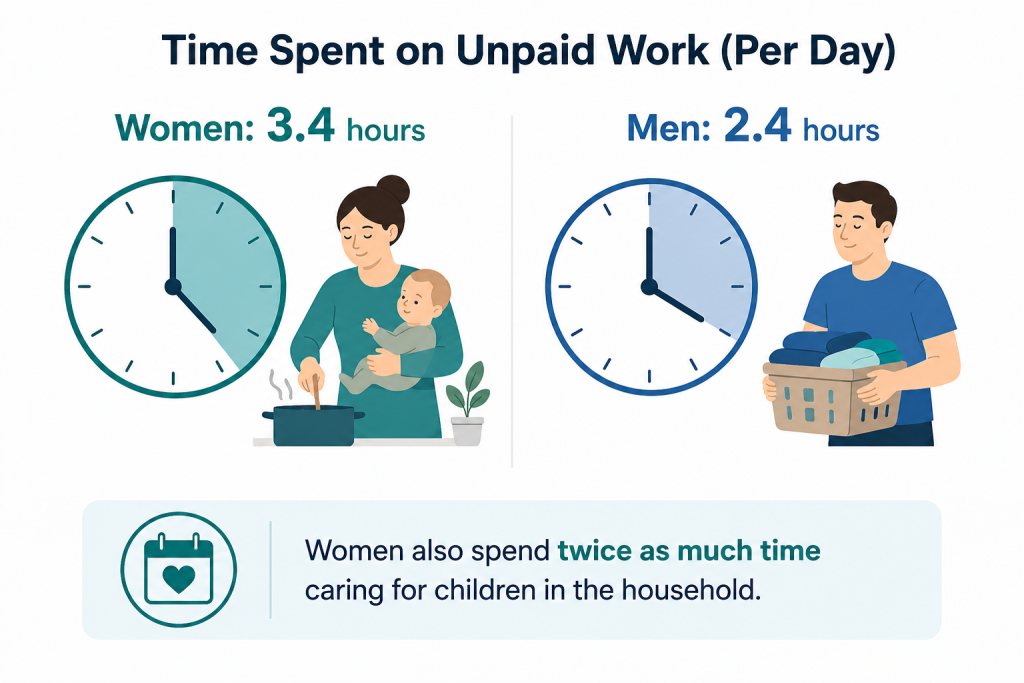
Research consistently shows that women continue to shoulder a greater share of unpaid domestic and family work. According to the Institut de la statistique du Québec, women spend an average of 3.4 hours per day on unpaid work, compared with 2.4 hours for men. They also spend twice as much time caring for children in the household.

Behind these numbers lies a very tangible reality. In many families, mothers continue to carry much of the invisible work involved in keeping family life running smoothly: remembering appointments, packing suitcases, planning meals, anticipating children’s needs, coordinating schedules, and making sure nothing is forgotten. This ongoing work of planning and anticipating often goes unnoticed, yet it requires constant energy.
Vacation doesn’t make this mental load disappear. In some ways, it can even make it heavier. Daily routines change, children are home more, travel increases, and unexpected situations become more frequent. For many mothers, vacation is therefore less of a break than a reorganization of responsibilities.
From a feminist perspective, it’s important to recognize that this exhaustion is not simply the result of individual choices or poor time management. It also reflects a broader social context in which caregiving, planning, and emotional labour continue to be carried disproportionately by women. Recognizing this reality does not mean that every family functions the same way, but it does help explain why many mothers feel particularly drained—even during a time that is meant to be restorative.
In this context, it can be helpful to pause and ask yourself a few questions.
What do I need right now? What usually helps me catch my breath? What nourishes me or helps me feel like myself? And how might I make even a little room for that during our summer vacation?
The answers will be different for everyone. For some, it might be a quiet moment alone with a book or a walk outside. For others, it could be a meaningful conversation or an activity they genuinely enjoy.
Even so, these moments can sometimes be difficult to find—or simply not enough to ease the weight you’re carrying. It’s perfectly normal for parents to need support, care, and someone to listen to them as well.
For many mothers, however, acknowledging that need can be especially difficult. Used to caring for others, anticipating everyone’s needs, and holding together the many moving parts of family life, they may feel they simply have to keep going, even when they’re exhausted. Asking for support often comes last.
If parents spend so much of their time listening to everyone else’s needs, who takes the time to listen to theirs?
How Can Active Listening Make a Difference?
Active listening offers something many parents rarely experience: a space where there’s no need to perform, solve problems, or take care of someone else. For a little while, the focus shifts to the person who is speaking. Their concerns, emotions, questions, and needs are welcomed with empathy, compassion, and without judgment.
For a mother who spends much of her time supporting others, this can be a genuine moment of relief—a chance to set down what she’s carrying, put words to her experience, and reconnect with herself.
Reaching out for support is also a way of recognizing that caring for yourself is part of caring for your family. Much like the safety instructions on an airplane remind us to put on our own oxygen mask before helping others, taking care of yourself is far from selfish. It is, in fact, essential if you want to remain emotionally available, attentive, and fully present for the people you love.
If your vacation hasn’t quite felt like the restful break you were hoping for, know that you’re not alone. Behind the smiles, family activities, and cherished memories often lies a great deal of invisible work, responsibility, and very real fatigue.
You deserve a space where you, too, can be heard, understood, and supported. Tel-Aide Montréal is here to care for those who spend so much of their time caring for others.
Sources
Institut de la statistique du Québec. L’emploi du temps de la population québécoise en 2022.
Femmes et Égalité des genres Canada. Faits, statistiques et incidence : égalité des genres.
Håkansson, C., Axmon, A. et Eek, F. (2016). Insufficient time for leisure and perceived health and stress in working parents with small children. BMC Public Health, 16, 1057.

