
Back-to-school Season: The Mental Load and the Very Real Work Mothers Do
For many families, back to school is more than the start of a new chapter. It is a full-scale logistical operation. And even today, mothers are often the ones coordinating it all. Buying school supplies, checking whether clothes still fit, filling out forms, getting routines back on track, and responding to messages from the school: the to-do list is very real. Back-to-school season highlights not only mothers’ mental load, but also the considerable amount of practical, often invisible work they do every day.
A Responsibility That Is Still Unequally Shared
Family dynamics are evolving, and many fathers play an active and meaningful role in their children’s daily lives. Every family shares responsibilities differently, based on its circumstances, strengths and needs. Yet research shows that, in many households, mothers continue to carry a significant share of family organization and day-to-day childcare.
This pattern doesn’t necessarily reflect a lack of care or commitment from either parent. It can develop gradually through work arrangements, caregiving experience, family habits and the expectations placed on mothers and fathers. As a result, mothers may carry not only visible tasks, but also the ongoing work of anticipating needs, remembering details and adapting when plans change. Back-to-school season simply brings this often-unseen work into sharper focus.
Average time spent caring for children each day
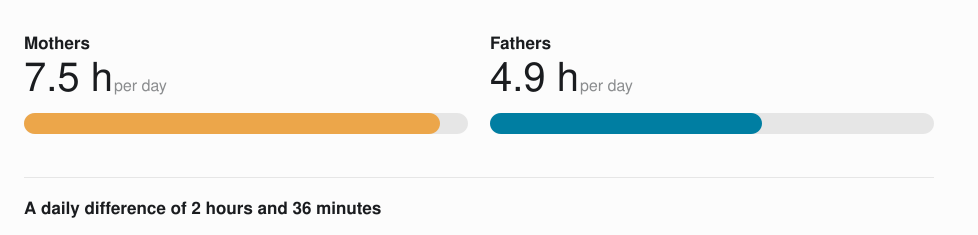
According to Statistics Canada, mothers spend an average of 7.5 hours a day caring for their children, compared with 4.9 hours for fathers. Data from the Institut de la statistique du Québec also shows that mothers of young children work fewer paid hours on average than fathers, suggesting that they are still more likely to adjust their schedules around family responsibilities.
These figures point to a reality that extends far beyond school supply lists. They remind us that, behind the visible tasks, there is another kind of work happening quietly in the background: keeping track of everything.
Keeping Track of Everything Is Work, Too
When we talk about the “mental load,” we often think of everyday tasks. But what wears people down is not only the amount of work that needs to be done. It’s carrying the responsibility of making sure everything runs smoothly.
Remembering PED days. Anticipating children’s needs. Planning lunches. Rearranging a schedule when something unexpected comes up. Keeping track of what's missing, what's coming up, and what absolutely cannot be forgotten.
Much of this work goes unnoticed. When it’s done well, no one sees it. Things simply seem to fall into place. But this constant vigilance doesn’t stop when children walk through the school doors. It often follows mothers into their workday and then back home again in the evening.
More Than Organization: Roles That Can Be Difficult to Balance
What can make back-to-school season particularly demanding is not only the number of things that need to be done. It’s also the feeling of having to keep everything in mind, even when responsibilities are shared: if a form is not signed, a child forgets their supplies, or an activity is not planned, you feel personally responsible.
This pressure is rarely expressed so clearly. It builds over time, shaped by the expectations society continues to place on mothers, as well as the expectations they may eventually place on themselves: being present, organized, patient, successful at work, and attentive to their children’s emotions, all without letting on how much effort it takes. A mother may begin to feel overwhelmed even when she’s already doing an enormous amount.

When Back to School Becomes the Last Straw
Back-to-school season can be difficult not only because so many things need to happen at once, but also because it may arrive when your resources are already stretched thin:
- The family budget is tight after summer expenses;
- A separation means rebuilding the family’s entire routine;
- A child needs additional support;
- A loved one is ill;
- The summer break didn’t provide an opportunity to truly rest.
Sometimes, all it takes is one forgotten item, one unexpected change, or one email from the school for everything to suddenly feel like too much.
You may recognize the feeling of always needing to stay one step ahead, of noticing what no one else seems to see, or of ending a workday with a “second shift” still waiting at home.
Perhaps you have found yourself crying over something that might seem insignificant on its own: a form discovered too late at the bottom of a school bag, a dessert forgotten on the counter, or a library book left at home. Not because these oversights had serious consequences, but because they happened in a life that was already at capacity. When this overload continues for too long, it can contribute to parental burnout.
You Deserve to Be Heard
It’s easy to believe that your exhaustion is not valid. After all, “it is only back-to-school season” or “other people are going through more serious things.” But you don’t need to be in crisis to need someone to listen. Chronic stress, guilt, the feeling of never doing enough, and constantly putting yourself last can all take a toll.
At Tel-Aide Montréal, we know that the people who call us are not always experiencing an emergency. Sometimes, they simply need a place where they don’t have to be strong, capable, or available to everyone else.
When you need someone to talk to, a confidential helpline can offer a non-judgmental space to share what you’re going through. Being heard can help you catch your breath, put your experience into words, and sometimes realize that you don’t have to carry everything alone.
A successful start to the school year isn’t about getting everything right. It’s about not forgetting your own needs along the way.
Note
This article focuses on mothers because data shows that, in many families, they continue to carry a disproportionate share of the mental load associated with parenting. We also recognize that families take many different forms and are not limited to households with a mother and a father. Families with same-gender parents, trans parents, blended families, single-parent families, and all other family structures face challenges of their own.

