
Never feeling good enough: the impact of comparison on our well-being
You’re scrolling through your feed, passing a shop window, or chatting with a friend. Suddenly, a thought crosses your mind: “I should be there by now,” “Something is missing in my life,” “I’m behind.” This feeling of inadequacy, as if you were running a race whose course you never chose, is familiar to many of us.
Yet, this discomfort does not always stem from a real failure. It often arises from an automatic reflex: comparison. Understanding this mechanism is the first step toward regaining your balance.
A human reflex, amplified by today’s context
In 1954, psychologist Leon Festinger described social comparison as a fundamental human need: to evaluate ourselves, we naturally measure ourselves against others, especially in the absence of objective benchmarks. Originally, this process helped individuals situate themselves within a group and make progress.
Today, this reflex is triggered in new and intense ways. We no longer compare ourselves only to our immediate circle, but to a multitude of curated, staged lives that are often far removed from reality. The problem is not the reflex itself, but the frequency with which it is activated and the context in which it occurs: we almost exclusively measure ourselves against what seems superior to our own experience, without access to the struggles or doubts that accompany those successes.
What science tells us
This is not just a feeling: it is a measurable phenomenon. Recent research, published notably in Frontiers in Psychology (2025), confirms that constant exposure to others’ “perfect” lives is linked to a decrease in self-esteem.
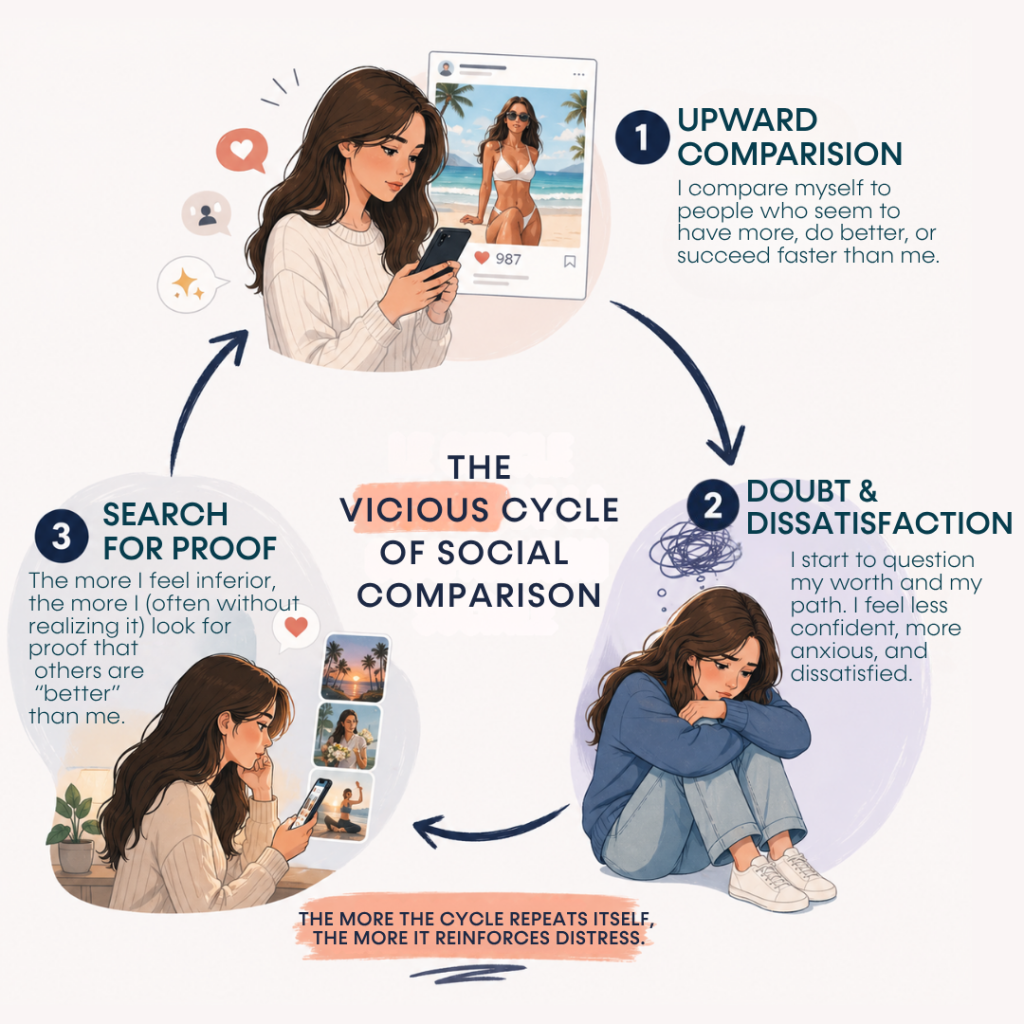
Other studies, such as those by Yang et al. (2025), specify the mechanism at play: “upward social comparison.” Simply put, this refers to measuring ourselves only against those who seem to have succeeded better or faster. Researchers have observed that this type of comparison acts gradually:
- It instills doubt about the value of one’s own journey.
- It is associated with increased anxiety, both regarding body image and professional ambitions.
- It creates a vicious cycle: the more inferior we feel, the more we (often involuntarily) seek proof of this inferiority in others.
How this mechanism influences daily life
This process often operates in the background, but its effects are very real:
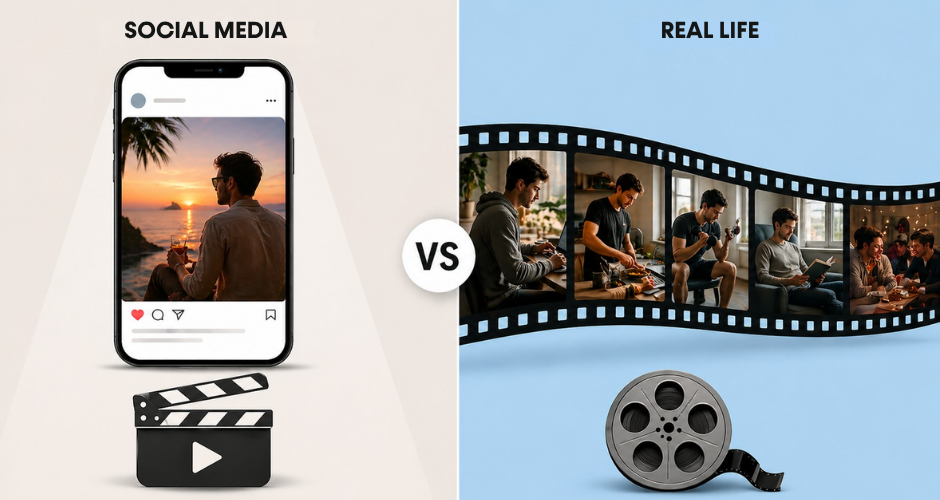
- The illusion of the full movie vs. the trailer: You confront your complete reality, with its shadows, doubts, and ordinary moments, against snapshots of others’ successes. This is an inherent imbalance: you are comparing an entire movie to a carefully edited two-minute trailer.
- A silent mental fatigue: Maintaining this constant rhythm of comparison demands continuous energy. It is an inner tension that, over time, can erode confidence and make one more vulnerable to daily challenges.
- The trap of shifting goals: The more we try to fill the perceived gap, the more we set new, often unattainable standards. The feeling of “never enough” then becomes an internal norm, rather than a passing exception.
Taking back control of your own story
Comparison is not a life sentence. It is possible to learn to identify when it becomes harmful and to disarm it.
1. Identify the trigger
Next time a wave of inadequacy overwhelms you, pause. Ask yourself: “What exactly am I comparing myself to? Is it reality or an image?” Naming the process creates space between the stimulus and your reaction.
2. Turn judgment into curiosity
Instead of telling yourself, “I’m not good enough,” try: “What does this situation reveal about my own needs or desires?” Sometimes, what attracts us in others is simply a clue to what truly matters to us, regardless of how the other person achieved it.
3. Refocus on your own benchmarks
Rather than trying to position yourself as “better” or “worse” than others, observe your own trajectory. What skills have you developed recently? What obstacles have you overcome? By focusing on your personal evolution, you replace the race against others with a conscious walk toward your own goals.
4. Cleanse your environment
You choose what you read or eat to take care of your body. Apply the same logic to your mental space. If certain accounts or sources consistently leave you with a feeling of inadequacy, give yourself permission to step away. Your mind deserves an environment that nourishes it, not one that depletes it.
Self-esteem: a daily pillar
Paying attention to your self-esteem is not a whim or an act of vanity. It is a concrete act of preserving your overall health.
At Tel-Aide Montreal, we view listening as a tool for reclaiming oneself. Speaking allows us to lay down the weight of comparisons, validate our experiences without judgment, and redefine our own criteria for success.
Your value does not depend on your position relative to others. It is inherent to who you are, here and now.
📞 1 877 935-1101 24/7 – toll-free – non-judgmental – with empathy
Scientific Sources Mentioned
Festinger, L. (1954). “A Theory of Social Comparison Processes”. Human Relations, 7(2), 117-140. Available at: https://shs.hal.science/halshs-02960620/document
Verduyn, P. et al. (2025). “The associations between social comparison on social media and mental health outcomes”. Frontiers in Psychology, 16. Available at: https://www.frontiersin.org/journals/psychology/articles/10.3389/fpsyg.2025.1597241/full
Yang, K. et al. (2025). “The Impact of Upward Social Comparison on Social Media on Mental Health”. Behavioral Sciences, 15(1), 8. Available at: https://www.mdpi.com/2076-328X/15/1/8
Important Notice
The information shared in this article is provided for educational and informational purposes only. It does not replace the advice, diagnosis, or support of a health professional (doctor, psychologist, psychoeducator, etc.). Tel-Aide Montreal offers a listening and support service, distinct from clinical therapy.

